

What Online Couples Therapy Is Really Like

Updated: Mar 17
Most couples do not start therapy because things feel mildly inconvenient. They start because the same fight keeps showing up in different clothes, communication has gotten tense or shut down, or love is still there but the relationship feels harder than it should.
If you are wondering what to expect couples therapy online, the short answer is this: it should feel structured, focused, and useful. Not like paying someone to watch you argue on Zoom. Good online couples therapy helps you slow the pattern down, understand what is actually happening underneath it, and practice better ways to respond.
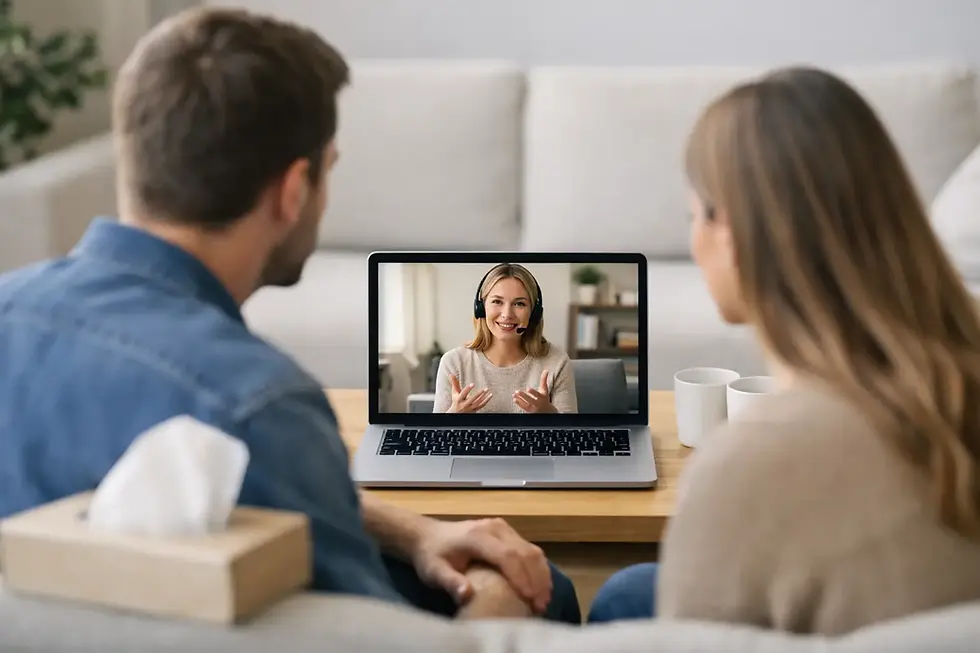
For many LGBTQ+ couples, there is another layer. You may also want a therapist who already gets minority stress, family complexity, identity issues, or the exhaustion of having to explain your life before you can even get help. That matters. You should not have to spend half the session educating the therapist.
What to expect in couples therapy online from the first session
The first session is usually less about fixing everything immediately and more about getting a clean map of the relationship. A strong therapist will ask about the current problems, how long they have been going on, what each of you wants to be different, and what happens during conflict.
You may also be asked about the history of the relationship - how you met, what works well, where trust was built or damaged, and whether there have been major stressors like infidelity, family rejection, relocation, parenting strain, or mental health concerns. This is not small talk. It helps identify whether you are dealing with a communication problem, an attachment injury, a recurring power struggle, or a mix of all three.
In online therapy, logistics matter more than people expect. You will likely need a private space, solid internet, and a plan for minimizing interruptions. If one of you is joining from a car between meetings and the other is at home with the dog barking, the session can still happen, but the quality of the work may suffer. Online therapy is convenient, but convenience works best when it is paired with intention.
Online does not mean watered down
A lot of couples worry that virtual therapy will feel less effective than in-person work. Sometimes that concern is valid. If the therapist is passive, distracted, or loosely organized, online sessions can feel even flatter than office-based therapy.
But when the therapist is active and methodical, online couples therapy can be highly effective. You are still talking in real time. You are still being interrupted when the conversation goes off the rails. You are still learning concrete tools for conflict, communication, emotional regulation, and repair.
There are even a few advantages. You are working in your actual environment, which means the therapist gets a more realistic feel for your dynamic. It can also be easier to attend consistently when no one has to fight traffic, rearrange a workday, or pretend they enjoy sitting in a waiting room after an argument.
Expect more than venting
This part matters. Couples therapy should not be a weekly recap of who was wrong on Tuesday.
Yes, your therapist needs to hear what happened. But the goal is not to referee every disagreement. The goal is to identify the pattern under the disagreement. One partner pursues, the other shuts down. One gets critical, the other gets defensive. One asks for reassurance, the other hears accusation. Different couples use different words, but the cycle is often familiar.
A results-driven therapist will help you spot that cycle quickly and challenge the beliefs feeding it. That may include assumptions like, "If I have to ask for care, it does not count," or "If my partner is upset, I am failing," or "If we disagree, the relationship is unsafe." These beliefs are not random. They usually come from attachment history, previous relationships, family systems, or stress that has gone unprocessed.
This is where evidence-based approaches matter. CBT and REBT can help identify the thought patterns that intensify conflict. Gottman-informed work can help with practical skills like repair attempts, conflict regulation, and increasing positive connection. Good couples therapy blends insight with action.
You may meet together and separately
Some couples are surprised when a therapist wants a joint session first and then one individual session with each partner. That is common and often helpful.
Individual sessions can clarify personal history, triggers, fears, and goals without the immediate pressure of managing your partner's reaction. They can also help the therapist assess whether couples work is appropriate right now, or whether one or both partners need added individual support.
That said, couples therapy is not secret-keeping therapy. Therapists handle this differently, so ask directly about the policy. In many cases, information that is relevant to the couple's work cannot stay siloed forever. Clear boundaries are a good sign, not a red flag.
What gets worked on in online couples therapy
Most couples come in talking about communication, but communication is usually the surface layer. Underneath it, therapy often focuses on trust, emotional safety, resentment, stress, sex, roles, and unmet needs.
You may work on how conflict starts, how quickly it escalates, and how to stop making a hard moment worse. You may learn to speak in a way that is more direct and less attacking. You may practice listening without preparing your rebuttal. Simple idea, hard skill.
If betrayal or a major rupture has happened, expect the work to move more slowly. Rebuilding trust is not a matter of one apology and a better calendar system. It usually requires consistent accountability, emotional honesty, and repeated repair over time. Anyone promising a fast fix is overselling it.
For LGBTQ+ couples, the work may also include stress that straight or cisgender couples do not face in the same way. Family rejection, identity invalidation, religious trauma, visibility concerns, internalized shame, and unequal levels of outness can all shape the relationship. Those pressures do not excuse harmful behavior, but they do affect how couples fight, protect themselves, and ask for closeness.
Affirming care means those realities are understood from the start. You do not need a therapist who acts impressed that they know what pronouns are. You need one who can connect identity stress to actual relationship patterns and help you do something about them.
Progress can feel awkward before it feels natural
One reason couples quit too early is that healthier communication sounds strange at first. If you are used to sarcasm, avoidance, mind reading, or escalating fast, then direct language and emotional accountability can feel stiff, forced, or even fake.
That does not mean it is not working. It often means you are using muscles the relationship has not built yet.
You may leave some sessions feeling relieved and close. You may leave others tired, exposed, or annoyed because your usual argument strategy just got named out loud. That is normal. Therapy is not supposed to be cruel, but it is also not supposed to protect every defense you have.
How to know if it is helping
If you are asking what to expect couples therapy online, it helps to know what progress actually looks like. It is not just fewer fights, though that can happen. Often the first signs are subtler.
You recover faster after conflict. You understand the fight beneath the fight. One or both of you catches the pattern earlier. Conversations get less circular. Requests become clearer. Defensiveness drops a notch. Repair happens sooner. You start using tools between sessions instead of saving all insight for the therapy hour.
This is one reason vague therapy frustrates so many couples. If there is no structure, it is hard to tell whether anything is changing. Good therapy should create measurable momentum, even when the relationship is still very much in progress.
What makes online couples therapy worth it
The best online therapy is not about convenience alone. It is about access to a therapist who is actually a fit.
That may mean someone who is LGBTQ-affirming, direct without being harsh, and skilled enough to do more than nod sympathetically while your relationship burns through another month. At Brian Sharp Counseling, that is the standard: you bring your story, and the work brings tools, structure, and honest feedback.
Not every couple should stay together, and good therapy does not force that outcome. Sometimes the most respectful work is helping two people decide whether the relationship can be repaired, what repair would require, and whether both are willing to do it. Clarity is a result too.
If you try online couples therapy, expect some discomfort, some honesty, and hopefully a lot less guessing. The right process will not make your relationship perfect. It should make it more understandable, more skillful, and more intentional than it has been lately. That is often where hope starts to feel believable again.


